

cockroach rape machine
on jealousy and the myth of the "hot girl" writer.

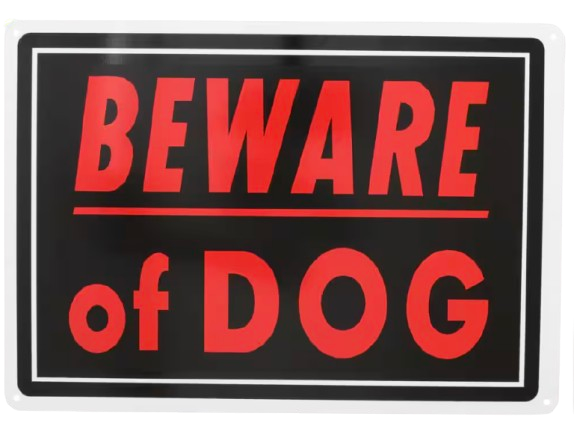
There is no door in my family home. No front door, at least. For the past twenty five years, well into failing adulthood, I have shed blood, sweat, and dignity in these rooms. For at least one of those years, I did not leave their confines. My father plucked our house from a catalog in the early 2000s, much before the housing crisis hit Hawai’i, when Hawaiians could still do such a thing. A mild recluse and full-time agent of fear, he chose the green trimmed two-story precisely for her doorless nature. My father is a classic ethnic man, one who rushes us to the airport 3 hours too early and believes in the power of a sign warning strangers to BEWARE OF DOG. In his mind, The “Stabber” will shift his plans at the mere threat of a gate.
But indoors, there are monsters that no sign will prevent. Where I live, cockroaches writhe under sinks, huddle together on linoleum. They dominate our nightscape. Our industries. Our dreams. It does not matter how clean we are; to stave off infestation, one must hire a small man to strategically place poison around the house, seven trumpeted angels. I hate these bugs. I hate their ability to fly. I hate that they only appear when you least expect them, when grabbing a midnight snack or walking to the club or resisting cutting yourself in the bathroom. I even hate the Hollywood hissing ones. I hate their demand to be seen, their attention seeking. My beef with this bug is historical. A mantra. A sport.
Father, the professional door-hater, is also a high school football coach. After one of his many games in my youth, he and I traversed the grass to his Ford. The sun had set as we passed the 30 yard line, then the 40, like ships in the night. Secret players waited at the ready, and I made the foolish mistake of investigating their turf. Roaches, various breeds, shimmied against and over my feet: squat, lithe, as small as a pebble, as large as my index finger, translucent, opaque, holographic trinkets in the Friday Night Lights. I begged Father to pick me up, but he wouldn’t. I was thirteen, too old for his strong hands.
What I hate the most about roaches is that no one ever saves me from them, that I must tend to myself in all my shivering when they make their cold appearance. I feel envious of places like Kentucky, where the cicadas only birth themselves from the ground in agony every seven years. I wonder if their deafening shrieks are worth the break.
I suppose I could blame the British. It’s so easy to blame the British, they are the worst kinds of white people, after all. Aside from imperialism, it is amongst their worst crimes that they brought cockroaches here. Before their crooked accents and teeth, Hawaiʻi had many kinds of inoffensive bugs. A fiery butterfly. A bug that munches wood. I even know another native girl who dedicates herself to finding the bugs that are left. She’s a starry eyed fool, picking through the dirt and sky. Most days, I feel it’s no use, all that searching. Those brown coffee beans will always traverse the fifty yard line, knock at the bottom of our houses, and buzz their wings with constant surveillance.
I am no secret to surveillance. The camera kept me glued to my doorless house. I didn’t start out on the internet as a writer. I figured that was my British mother’s vocation, the work of a girl who wrote her first story at five and has written twenty novels. I, on the other hand, have been making ragebait content since I was 21, pushing my fat tits into an ill-fitting tank, baring my translucent wings to strangers, and crying in the comments section. After spending so much time in a relentless observation cycle, considering myself a serious artist felt like cosplay. I was too self-obsessed, too confessional, too busty.
Just as it always will be, a particular Substack essay recently pissed us off. In Look at me, I’m a Hot Writer, Sarah Manavis ruffles the feathers of everyone in the digital ether. Manavis makes the argument that “attractiveness” determines a modern writer’s success rather than the quality of the work itself. She digs. She bites. She complains about the qualms of marketing. And, just as each foolish girl is bound, she utters a disruptive, grating string of words: I’m not sure anyone who presents themselves as a ‘hot writer’ writes anything lasting.
I have lived many exploited lives on the internet, many by my own hand. I’ve spoken too much. I’ve shown a lot. I’ve become a meme to 4chan incels. My online persona garnered me both online and real life abuse. So, I retreated for a few years. Until I found her.
What Manavis calls a “hot” writer, I call the Girlwriter: Confessional. Introspective. Bordering self-obsessed. Sometimes she’s not a girl at all. But, she allows the audience to project onto her, to make community with her image. They ingest her alternative literature. They ingest her life. Mackenzie Thomas, an exceptional artist and Girlwriter with a one-woman show, urged me to become one too in my most freakazoid era of life. At the time I was a bit jealous of her, her ability to become real, to create rooms with doors and doors and doors. So, I followed her through this one.
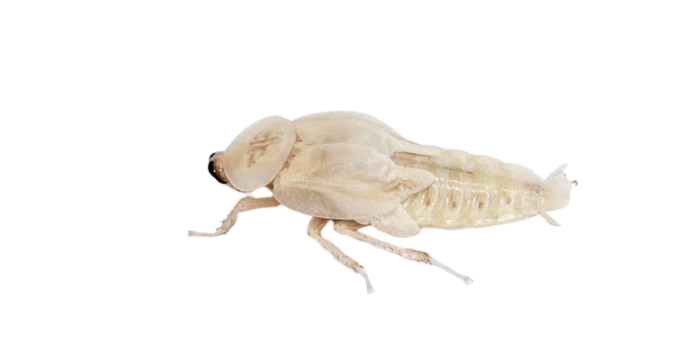
I owe it all to her, becoming reborn– a roach shedding its skin into albinism. Because, if you’ve ever seen one of those wretched things, none are actually born-that-way. To baldness. To castration. I shed everything for the nunnery of the keyboard. Spiritualism.
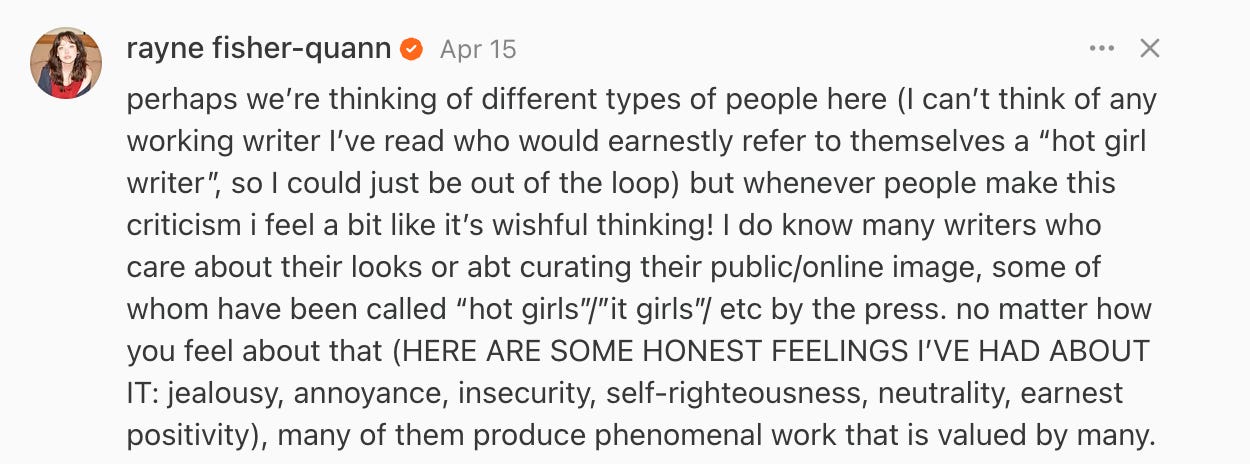
Sure. What Manavis said enraged me because it felt, to a degree, honest. Throughout my journey in developing a writer’s voice over the past two years, I have not and will not find freedom from self-marketing. No writer will, independent, published, or socialmedia-fied. Rayne Fisher Quann, the talented Girlwriter of all Girlwriters who should probably be receiving royalties for her sole popularization of this app, expertly pointed out what rubbed me in Manavis’ incomplete narrative.
I need you to know, I left the house after my isolation, starving.
There I was in my garage, daring to cross a garlic threshold after months of vampirism. Sunshine ricocheted off the pavement with a loud hum. A group of construction workers lounged on the asphalt on top of a sewage hole. While it didn’t seem like the most promising social interaction, I figured any cordiality would count. The men, one with a beer belly and the other swimming in orange dri-fit, crouched at the upturned cave. I wondered if they could distinguish my morning shit from my neighbor’s morning shits as they communed with the hole. Its depth called to me, a mysterious siren in a suburb disrupted.
As I approached, Beer Belly gave Skinny a side eye. I did not catch the rhythm of their joyful giggles until my delicate head hung, eyeballs first, over the tunnel lined with atrocity: a hoard of cockroaches, palm sized and squirming. I screamed all fifteen feet of the way home.
I figured my cordiality would count all the same as a writer, too. I hoped no one would notice my entrance; hoped all the pressure and performance would fall away. Not of hotness, because taking one’s busty self seriously is only half the battle, but of pressure from the salon. From the apparatus in which we are all locked, a machine that values both a proximity to power and a removal of our contexts. It clicks and clanks and reprimands you to dimes-squareify suffering, to laugh instead of name-the-thing, to become digestible. Cutting. I resonate with Manavis, for reasons she did not identify but must feel all the same. With Rayne, too.
I am green.
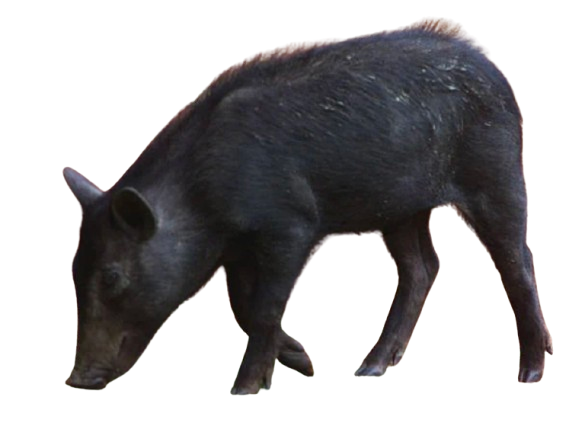
There is a man who lives in Hawaiʻi, just as there are girls who live in Hawaiʻi. He lives like some of us, particularly the white hippies, but he looks like many of us indigenous people without a British parent. He is autistic, reclusive, funny, and a blogger, like me. He moved here right before the pandemic from my favorite city, New York, after making it big as a player in the alt-lit scene. He has made himself, for all intents and purposes of the Substacker eye, belong. He writes essays about his cat. He provides feral pig updates. Publishers love him. People find his insufferable nature charming. I do too. I am an insufferable woman, after all. And when I think about being envious, of being so jealous it makes me want to tear my skin off, I think of this image:
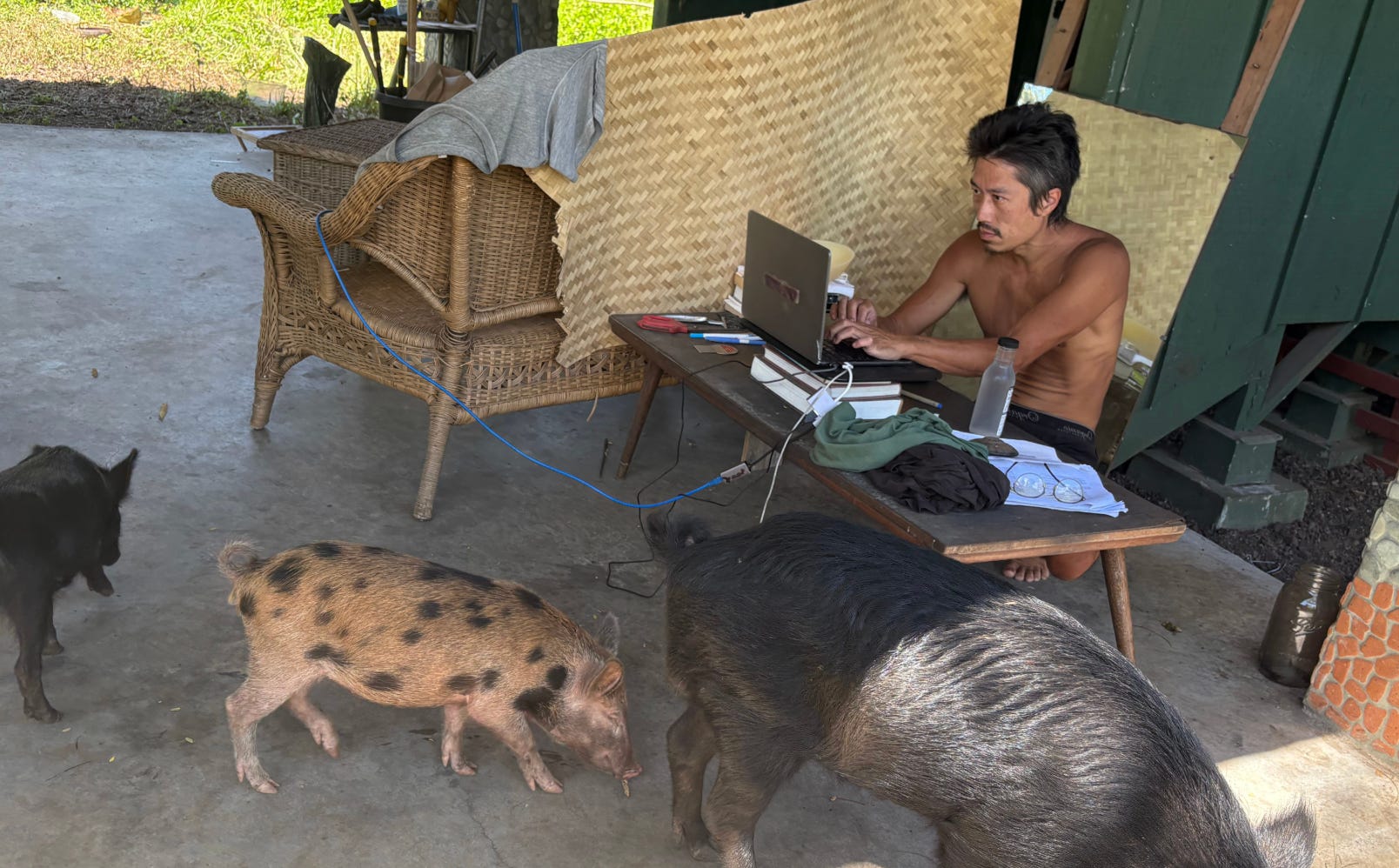
Father, the abandoner and professional door-hater, also raised me around a kingdom of pseudo-feral pigs. I say pseudo-feral because while high up in the mountains one might see a black shadow fly across the road, we don’t have much land to play with anymore. On Oʻahu, industries remain homogenous. For dollars, we can fill the fat bellies of sunburnt Middle Americans, massage the cheese toes of richies, market some polyester, build condos on top of condos, or become infantrymen. My father chose to build condos. I chose to be a broke freelancer.
So it was that this girl-failure and her father would visit the pigs in cages at his construction business. They were also fat-bellied and biting, particularly when they would have babies. We’d eventually cook them for parties. My dad and I would refrain from the feast, opting to watch his brothers fight after too many Heinekins instead.
My fascination with this image began during an artist residency I invented. By the grace of God, or perhaps nepotism, my best friend Kapu and I won a 10,000 USD grant on which to pay taxes. We split the money to live in an apartment donated to us for a few months together, away from our cramped, multi-generational homes. To us, this apartment was a jackpot. I slept on the couch next to the kitchen. His snoring took the master bedroom. In the morning he and I would meet at the table with coffee to show each other art that made us jealous. Usher in Tao Lin’s I went Fishing When I was Five.
Kapu, unlike myself, fished when he was five. He remembers the stories of Hawaiians eating turtles before endangerment. He resents the boars in his backyard, finding them to be nuisances rather than friends to hoard. He is a real Hawaiian, away from Oʻahu’s copious military bases and weak ethnic self-esteem. The funny thing about Kapu and Tao Lin is that they both live on the same island. They raise similar hermetic community concerns in their Facebook group. But I wonder: Are feral pig updates from someone like Kapu, from someone like me, interesting to the viewer? What about a photo of us in a lawn chair in waikiki? On a base? In our yards? I think not. And if not, why?**
There is a woman who lives in Hawaiʻi, too, just as there are girls who live in Hawaiʻi.
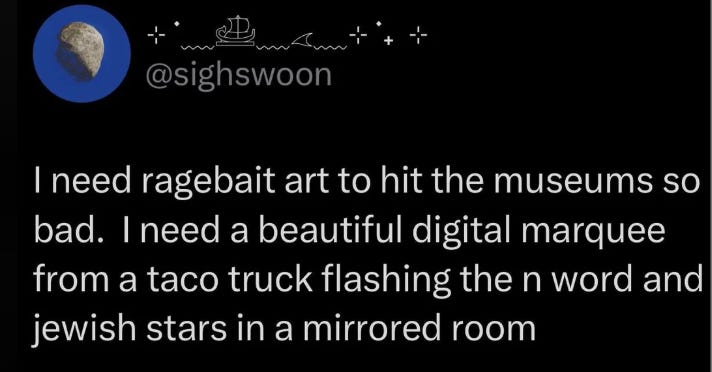
Gabi Abrão (also known as @sighswoon) got her start at writing through instagram. In an interview with Nylon, Gabi explains starting her account as a way to “anonymously talk sh*t,” and, through her development and hustle, became “way more spiritual and introspective and aesthetic.” I came to know the writer through her curated Digital Resting Points, rants about “anti-sun rhetoric”, pro-AI art sentiments in the time before its technological solidity, and her move to Hawai’i during the pandemic.
We have a certain affinity, Gabi and I. Gabi memes like me. Gabi is mixed like me. Gabi forms a vessel, a sharer of an audience’s projected ambiguity, like me. Gabi talks about sex like me. Gabi writes poems like me. Gabi posts body like me. I like to think we have some sort of alliance in this way, as women under pressure. Under the machine. I even remember getting into a fight on her livestream many years ago, questioning her choice to move here. I’m sure she doesn’t remember. I barely do. We are now only a gem of a moment, fractals shining in distant memory. Fighters and forgetters, aren’t we?
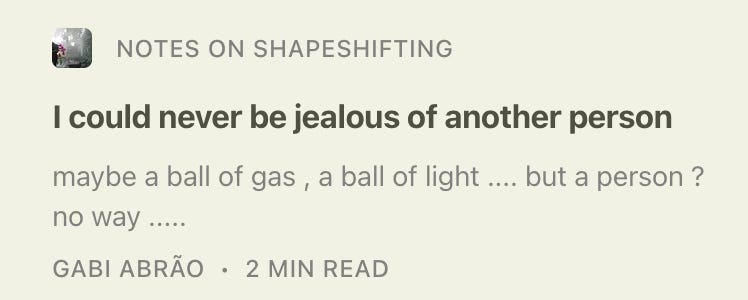
In her debut collection Notes of a Shapeshifter (2022), Gabi also wrestles with the nature of pigs and what seems to be her least favorite bug. Her poem titled I Am Allergic to Mosquitos and Your House is Full of Them details her relationship to a man who lives in Hana– the “Hunter Archetype”– otherwise known as Jamey.
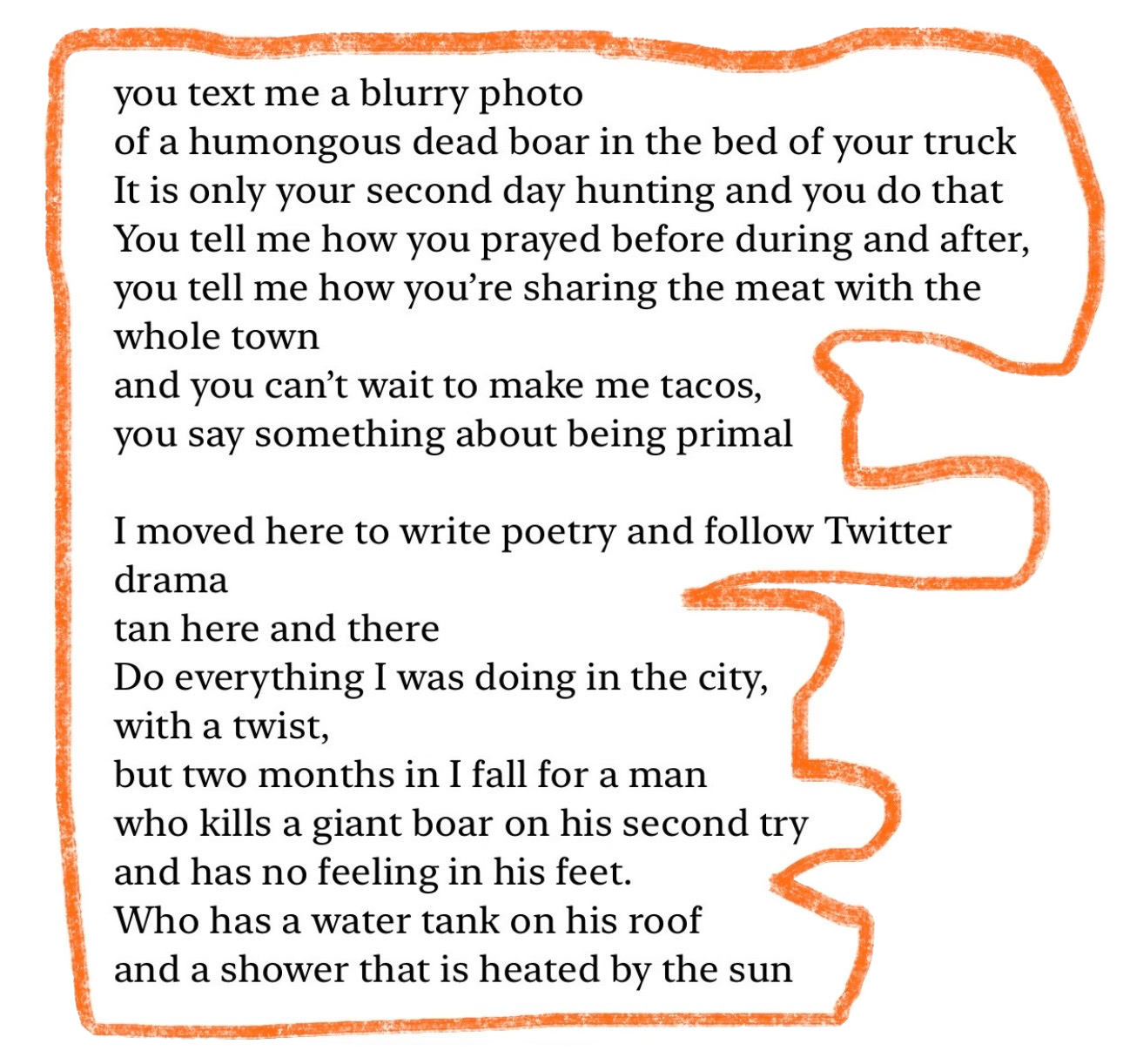
Gabi’s reference toward the “primal” seeks to conjure a universal human truth. But, I argue that there is no universal human truth. In a place like Hawaii, context matters or, at least, adds a certain sepia to a photo. While I have an inkling that Jamey is not indigenous, let alone from here, I don’t think this distinction matters much. Confessional writing requires a level of autobiographical vulnerability. This purview rises from her perception of land, of love, and what brings her freedom. She concludes:
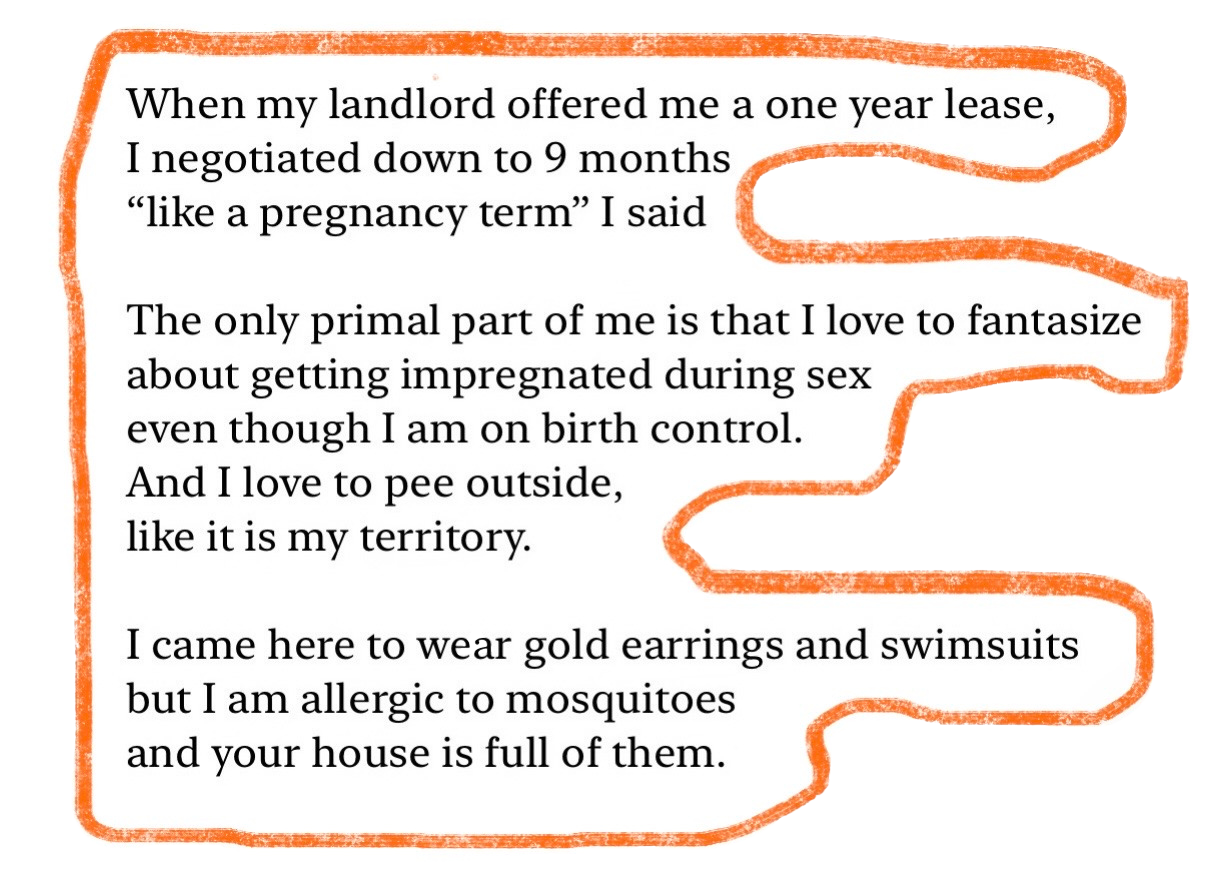
To Gabi, Hawaiʻi is a place to achieve pissful earth-mother bliss. A place of solace and bikinis. Of golden escape. Of primitivism and pregnancy and “territory.” Of isolation and reintegration at her will and her whimsy. In another piece titled I don’t want anyone to read this she details an adolescent relationship before discussing the health benefits of Ayahuasca:
She was an emo who cut herself when I met her but by the time it was the summer after 8th grade we were two hippies calling each other Sunshine and Indigo… In 9th grade, it was spirit week at school, and it was Tuesday, and it was native american day, I’m not even kidding. And we were hippies. We already had moccasins and face paint we stole from Michael’s. We went all in that day. And guess what? It rained that day. It rained long and hard in the quad. And what did we do? On native american day at school?... We danced in the rain, at lunch time, at school, in the middle of the day. Soaking wet. And we were so happy.
Sam Kriss identifies the alt-lit as a “mode of writing that’s unmannered, unaffected and natural,” as well as a form holding “a deeply conservative ethos”. At the core, an alt-lit writer needn’t “exercise the creative imagination or try to forge a new and surprising path through words: just open up”. He references Tao Lin’s book Leave Society, a piece that concludes in a similar orgasmic climax as Gabi’s– that “six thousand years ago a peaceful, matriarchal, nature worshipping society was violently overthrown” and the only way to reach equilibrium is by, well, leaving.
Our shared question for alternative literature, for the Girlwriter, is: Alternative to what? In a world inundated with diaristic slop, I believe that writers search for honesty, craft, and storytelling that leads back to a larger source of knowledge. The children yearn for the uninhibited native, a voice that can both confess and assert itself with confidence and credentials about the external world. In the machine, scene-y writers ache for context while feeling it impossible to attain under the capitalistic structure of Western life. They seek spiritualism without genealogy, believing the only way to achieve truth is escape. But, their escape becomes inevitably flattened, decimated by its deviation from source material in a fascist world.
Kriss also calls into question the readiness for people to label these works fascist. To an extent, I understand the hesitancy. I am thoroughly ready for certain players to label me a “woke hater,” them as the truth-seekers transcending the system by not taking things too deeply, by battling identity with what can be deemed insincerity or negligence or a 2D version of God. But, I must make my intentions clear. There is a manifest destiny here that no one seems to critically think about or, perhaps, are too afraid to name.
I would be remiss to mention both writers debated ties to edgelordeism. Gabi’s newest collection, exclusively published by Daniel Lisi’s controversial “Not A Cult" press, reworks Donald Trump and Kanye tweets into punchy found poems. Gabi whistles in her social presence as well, a sort of thing that goes under the radar to the common instagram viewer and full blown on X/discord, going as far as to reference ICE shootings as a “sort of relief,” of wokeness as opposition to experimental culture. While writing this essay and to my extreme disappointment, I found out that Tao Lin contested his involvement in a 2014 statutory rape allegation by picking through age of consent law. I say these public assertions plainly not to make the hogs angry or to insinuate that either their craft has failed due to their malformations. But, Kriss concludes with a statement that places a nail in all of our coffins: “it’s downright baffling that [we] think there’s anything remotely subversive” in all of this.
Hawai’i is a perfect backdrop to show you that all writers prostrate themselves against the floor to look for bugs. There is so much red dirt to parse through, after all. Who succeeds is a matter of who has the tools. The sturdiest shovel. Everyone seems to find something esoteric here, from Joan Didion at the Royal Hawaiian Hotel to the Grateful Dead transplants finding themselves in Puna. The natives do too, but we hold a certain space within confessional writing that people only want to a certain degree: Ugly. All we have to dig are plastic spoons. What happened to us is too poor to project onto and too depressing to masturbate.
In our brief time together in the jackpot studio, Kapu and I spent many minutes killing roaches together, dampening our laughter with a sobering realization. For writers like us, our relationship to homeland might provide certain opportunities within a pandering framework– a grant here and there, a moment of recognition when we are good, presentable natives, a star on the chart for what Kriss identifies as a market that “sells itself on the marginalized identities of its authors.” But, to holistically confront our context would be something too layered to present. The world isn’t ready for us. Our identities are a heavy, inescapable, and unattractive cage.
I was warned by the TikTok feminists before I saw it. That is, somewhere in the ether exists a a viral image of cockroaches in a line, splayed open on their crisp backs and tied down with some sort of invisible glue, with steel rods fucking their cockroach pussies. It was not long before my algorithm delivered the ungraceful image to my feed so I could witness it myself.
At risk of sounding like a semantics nerd, I must assure you that the roaches themselves are not actually being raped. The rods pulverize their organs through their abdomen rather than their oviducts. But, to know that a man constructed each prong to at least appear as such forced me into empathy for a bug to which I did not consent. One might think it would feel good to see the opposition tortured, but alas: I have a heart. All of this is absurd. And, though Manavis purports “there are many ways we feed into the oppressive forces we seek to evade… [it] doesn’t mean we shouldn’t try to resist them,” as the rods plow writers into the market’s oblivion I feel it more important to turn the tide back onto the consumer. The reader. You.
Whether or not my work “speaks for itself” is an uninteresting criticism. We are all a part of the machine. When we are not cockroaches, we are the witness watching them. Some of us even articulate the saw trap. Our game does not hinge on how hot we can make ourselves or how we can bend to your taste. It’s about you. What do you want to read? What are you willing to excuse without question? Without criticism? Without thought? What absurdity are you willing to endorse? Ignore? What do you find attractive?
My insides may spill onto the page in a pink, sputtering boil, but I am a writer. No one can take it from me, from Gabi, from Tao Lin, from Sam, from Sarah. We are plumbing the depths searching for something in grime. I simply urge consumers to level their jealousy for a better cause. We deserve to tell and ingest stories with layers that make us so full we have to take a second before swallowing anything else. We could yell at one another in a loop about how we lack substance forever, or we could garner some self responsibility.
As I write, I am huddled in my room. I open Instagram. I see that Tao Lin is trying to cure his autism with LSD. Gabi just bought her first house on Maui. I will feel jealous before doing my daily rounds: Make my coffee. Be angry with Father, with myself. Take my Ritalin. I will end the day with a THC tincture and think about how AI is forcing us into technological evolutionary degradation, how at some point even our fear will dissipate because we– somehow– always have an answer. When I get especially bored, I will speculate about the miles distance between our triptych, how we are so close yet so far, triangulating each other like stupid UFOs. We all weathered the storm, back in March. But where Gabi posted think-piece notes on being without a phone for a day, my Uncle lost his farm. Identity is a cage for us all but the bars are thicker for some. The guard is on steroids for some. Some of us bribe them with food. Others complain. We all get steel-fucked.
As I fall asleep tonight I think I will ponder Gabi’s million-dollar fixer-upper. In fact, I will shift into her reality, like those pandemic girls with the maladaptive daydreaming disorder. I will circle her front porch with the peeling paint. I will trace my fingers against the splintering wood. I will float down the hallway like a ghost. I will watch her bathe, watch her cradle her fertile oviducts in the tub. I will rummage under her sink. I will set traps. I will do everything to know for certain: Are there bugs in your house? What kinds? How many?
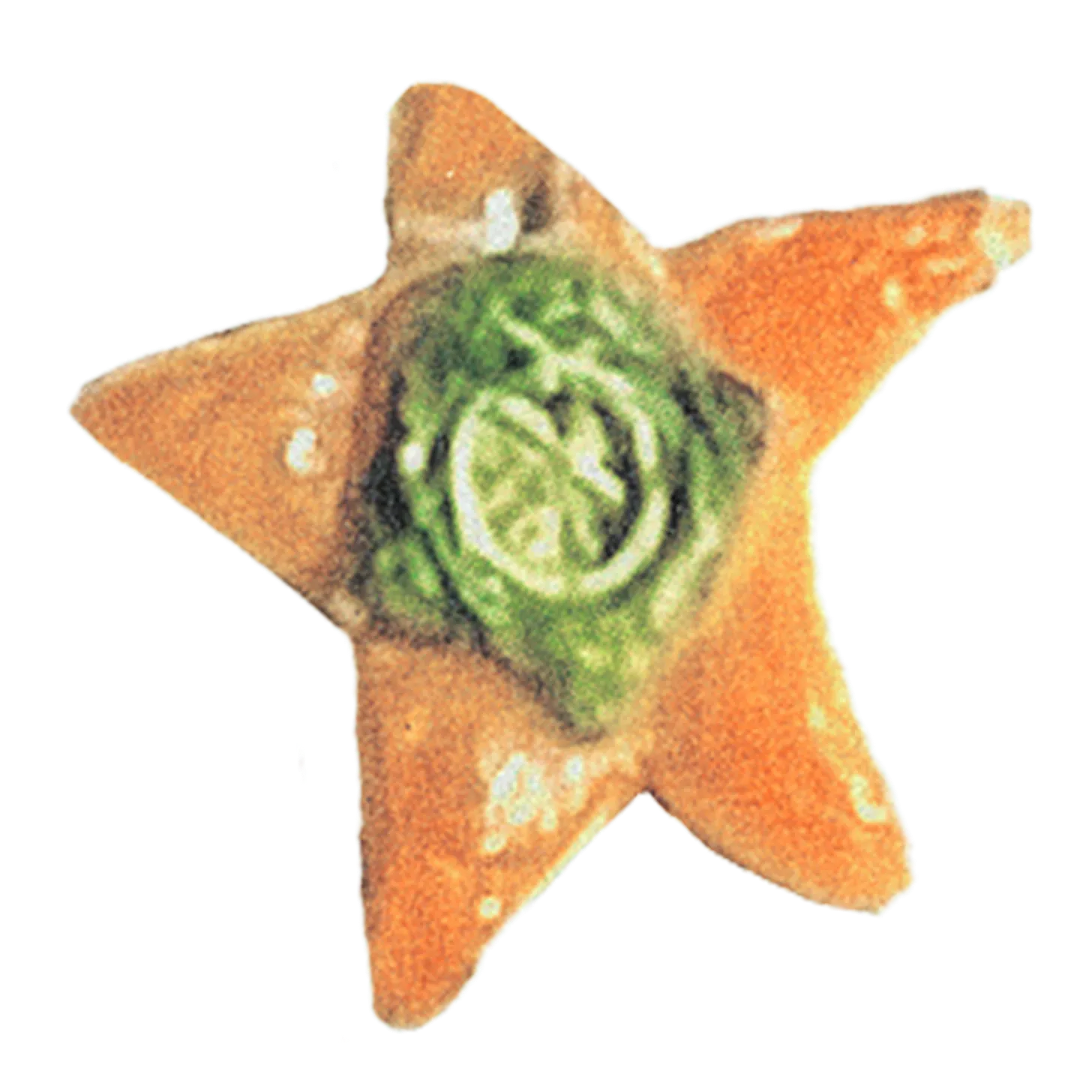
As the hallucination fades I will finally see them, those little stars: cockroaches crossing from the yard into the kitchen. I will count them like jumping cloud-lambs over the sleep gate. Mosquitos flying in and out of a storm drain. Pigs through a front door. I will count them until I become palm tree and mango and hunter and roach combined, falling back into her paradise; my prison. Asleep.
** Kapu is actually an artist and a writer himself. He is my dearest. He mans the substack Post-Nai as well. Here’s a really good piece on the Honolulu triennial, however, you might want to do some research into the art world here beforehand.
this is exactly the type of piece that i have to sit on before swallowing anything else, the type that will only ripen and get more beautiful in time. i never comment but this is a great piece i'll be reflecting on for awhile
Love! You’re a fantastic writer from what I can tell here. Side note: in Kiswahili “beware of dog” translates to MBWA KALI and has been my dad’s email address since email was invented.